Book An Eye Test in Sheffield
- Local Expertise: We’re Sheffield-based opticians, dedicated to providing top-quality eye care in the heart of the city.
- Personal Touch: Our optometrists work exclusively here no locums or stand-ins so you’ll always see a familiar face.
- Friendly Atmosphere: We pride ourselves on being approachable and welcoming, offering a relaxed yet professional experience.
- Advanced Care: Using the latest technology, we ensure your vision and eye health are in the best hands.
- Focused on Excellence: Our goal is to be one of Sheffield’s best opticians, with care tailored to you.
Book your eye test today online or call 0114 267 1828
Types of Eye Tests We Offer
Additional Notes on Our Eye Tests
- Enhanced Private Eye Examination: Includes advanced imaging for early detection of conditions like glaucoma and macular degeneration. Ideal for comprehensive monitoring.
- Enhanced NHS Eye Examination: Designed specifically for patients over 60, with specialized tests to address age-related eye health concerns.
- Basic NHS Eye Test: Incorporates Fundus imaging for future comparisons alongside standard eye health assessments.
- Student Over 19’s Examination: Offers a 10% discount on purchases, making it a cost-effective choice for students.
- Contact Lens Aftercare: Patients on the Plan Replacement Scheme receive a 20% discount on spectacles. Combined eye tests and aftercare are available upon request.
Why Choose us?
Getting regular eye tests is essential for maintaining good vision and overall eye health, yet many of us often overlook this simple task until something feels off. Have you ever experienced a headache after staring at the computer for too long or struggled to read street signs? These could be signs that it’s time to check in with an optometrist. Booking an eye test doesn’t have to be a hassle either—thanks to modern technology, we can easily schedule our appointments online. In this article, we’ll explore how to book your eye test, what to expect during your visit, and tips for making the most out of your experience at Daybell & Choo. Whether you’re due for a routine check-up or experiencing specific concerns, taking proactive steps towards your eye health starts here!
You can book an eye test through our website by using the online booking system, where you can choose your preferred date and time. Alternatively, you may contact us directly at 0114 267 1828 to schedule your appointment with one of our experienced optometrists.
Why Regular Eye Tests Matter
Eye tests are more than just about your vision—they’re a window into your overall health.
- Detect early signs of glaucoma, cataracts, or macular degeneration.
- Identify conditions like diabetic retinopathy before symptoms arise.
- Ensure your prescription is always accurate for the best visual clarity.
We recommend:
- Every two years for adults.
- Annually for children or those at higher risk (family history of glaucoma, age 40+, etc.).
If you notice changes in your vision or experience discomfort, don’t wait—book an appointment right away.
Step-by-Step Breakdown:
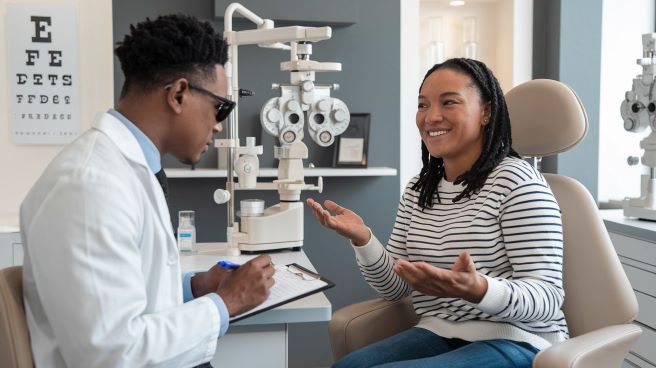
1. Patient History Discussion
- What Happens:
- Your optometrist will ask about your medical history, any vision concerns, and lifestyle needs.
- Why It’s Important:
- Helps us tailor the exam to your specific requirements and identify any potential risk factors.
Step-by-Step Breakdown:
1. Patient History Discussion
- What Happens:
- Your optometrist will ask about your medical history, any vision concerns, and lifestyle needs.
- Why It’s Important:
- Helps us tailor the exam to your specific requirements and identify any potential risk factors.
2. Visual Acuity Test
- What Happens:
- You’ll read letters on a chart (commonly the Snellen chart) to measure how clearly you can see at various distances.
- Equipment Used:
- Snellen Chart or LogMAR Chart.
- Why It’s Important:
- Identifies any refractive errors, such as nearsightedness, farsightedness, or astigmatism.
3. Refraction Test
- What Happens:
- Using a device called a phoropter, the optometrist will ask you to compare lens options (“Which is clearer, 1 or 2?”).
- Equipment Used:
- Phoropter or Autorefractor.
- Why It’s Important:
- Determines your exact prescription for glasses or contact lenses.
4. Eye Muscle Function Test
- What Happens:
- You’ll follow a small light or object with your eyes to check the movement and coordination of your eye muscles.
- Why It’s Important:
- Ensures your eye muscles are working properly and aligned.
5. Pupil Response Test
- What Happens:
- The optometrist shines a light into your eyes to see how your pupils react.
- Why It’s Important:
- Checks the health of your optic nerve and overall neurological function.
6. Retinal Exam (Also called Fundoscopy)
- What Happens:
- Using a tool called an ophthalmoscope or performing an OCT scan, the optometrist examines the back of your eye, including the retina, macula, and optic nerve.
- Equipment Used:
- Ophthalmoscope or OCT Scanner (Optical Coherence Tomography).
- Why It’s Important:
- Detects signs of conditions like diabetic retinopathy, macular degeneration, or retinal detachment.
7. Intraocular Pressure Test (Tonometry)
- What Happens:
- A small puff of air or a gentle touch is applied to your eye to measure pressure inside the eye.
- Equipment Used:
- Non-contact Tonometer (puff of air) or Goldmann Applanation Tonometer.
- Why It’s Important:
- Detects elevated eye pressure, a key indicator of glaucoma.
8. Peripheral Vision Test (Visual Field Test)
- What Happens:
- You’ll be asked to look straight ahead while identifying objects or lights appearing in your peripheral vision.
- Equipment Used:
- Humphrey Visual Field Analyzer or similar.
- Why It’s Important:
- Detects blind spots or vision loss caused by glaucoma or neurological issues.
9. Corneal and Lens Exam
- What Happens:
- The optometrist uses a slit lamp microscope to closely examine the front structures of your eye, including the cornea, iris, and lens.
- Equipment Used:
- Slit Lamp Microscope.
- Why It’s Important:
- Identifies issues like cataracts, corneal damage, or dry eye syndrome.
Booking an eye test with Daybell & Choo is simple and convenient. You can call us directly at 0114 212 4038, visit our practice in Sheffield, or use our online booking system to secure your appointment.
We are located at Daybell & Choo, 290-294 Sharrow Vale Road, Sheffield, South Yorkshire, S11 8ZL. Conveniently situated off Ecclesall Road, we serve patients from across Sheffield and surrounding areas. Parking and public transport options are available for your convenience, you can find the street view on our about us page if you need a better idea.
No referral is needed to book an eye test at Daybell & Choo. You can schedule an appointment directly, whether for routine care, specific concerns, or specialized services like dry eye treatment or contact lens fittings
- Current Glasses or Contact Lenses: Bring any glasses or contact lenses you currently use, including prescription sunglasses.
- Your Prescription: If you’ve had a recent eye test elsewhere, bring a copy of your latest prescription.
- Medication List: If you’re on any medication, especially those that might affect your eyes, bring a list or the actual medications.
- NHS Eligibility Proof: If you’re booking an NHS eye test, bring proof of eligibility, such as a benefits letter, student ID, or age documentation.
- Eye Health Information: If you have a history of eye conditions or any relevant medical reports, bring those along.
- Insurance Details (if applicable): If using private insurance, bring your insurance card or information.
- Arriving 10-15 minutes early is recommended. This allows time for:
- Fill out any necessary paperwork.
- Discuss your medical or vision history with the staff.
- Relaxing before your test begins.
If you’re unsure about what to bring or need assistance with forms, arriving early ensures everything is handled smoothly.